Federation of Bangladesh Chambers of Commerce and Industries president Md Jashim Uddin said that the Bangladesh Bank’s new guidelines for the payment of bank employees’ salaries would hinder banks’ lending to cottage, micro, small and medium entrepreneurs.
The FBCCI president came up with the observation at a webinar on ‘Bi-annual economic state and future outlook of Bangladesh economy: private sector perspective’ organised by the Dhaka Chamber of Commerce and Industry on the day. Speaking about the BB’s guidelines, Jashim requested the central bank to relax the guidelines so that the banks can serve the CMSMEs. He thanked the central bank for allowing banks to open sub-branches and agent banking.
However, he said that the banks would not be able to compete with the micro-financial institutions or non-government organisations if the BB’s guidelines on bankers’ salaries remain unchanged. NGOs can appoint a field officer at Tk 10,000 monthly pay and the entities can charge interest at above 20 per cent, he said.
On the other hand, banks are not allowed to charge more than 9 per cent interest on their borrowers, he said, adding that it would be tough for banks to compete with NGOs.
To strengthen the CMSME sector, he also asked the central bank to specify the sub-sector-wise lending targets for banks. Highlighting the importance of CMSME sector in different economies, DCCI president Rizwan Rahman said that the sector contributed only 25 per cent to Bangladesh’s GDP and that was significantly lower considering its contribution in India and China.
Most of the loans under stimulus packages are disbursed among medium industries, Rizwan said. To solve the financing issue, the central bank should set separate targets for the cottage, small, micro and medium entrepreneurs, he said. Rizwan also proposed that a separate bank for the cottage, micro and small entrepreneurs should be allowed to operate as only the medium entrepreneurs can only fulfil the requirements of traditional banks.
The governor also agreed to separate CMS and medium parts of the CMSME loans to emphasise the CMS segment. Speaking about the inflation, the governor said that the central bank was closely monitoring the inflation as it was creeping up during the coronavirus in the country and it was a global phenomenon.
Speaking about the country’s plan to attain $80 billion export earnings by 2024, Metropolitan Chamber of Commerce and Industry president Md Saiful Islam said that the country had attained significant growth in export earnings in the current fiscal year mainly due to the peace and tranquillity prevailed in social sector of the country for past two and a half year.
Saturday, February 19, 2022
Federation of Bangladesh Chambers of Commerce and Industries gives suggestion to Bangladesh Bank

Tuesday, February 8, 2022
BEXIMCO Group takes control of Fareast Islami Life Insurance
Beximco Group has taken control of board of scam-hit Fareast Islami Life Insurance Company Limited by purchasing 19.81 per cent shares of the insurance company.
On February 3, the Bangladesh Securities and Exchange Commission gave its nod to the group to nominate representative of the BEXIMCO Group for the board of Fareast Life, BSEC officials said. The new board of directors can start activities after taking consent from shareholders at upcoming annual general meeting of the company.
Besides, the new board must comply with individually 2 per cent and jointly 30 per cent shareholding rules of the BSEC. Tradenext International Limited and Jupiter Business Limited, two associate companies of BEXIMCO, purchased 9.91 per cent and 9.9 per cent shares of Fareast Life respectively in recent days. On January 30 this year, both companies applied to the commission to be directors of Fareast Life.
As per the approval, the companies namely Tradenext International Limited and Jupiter Business Limited who hold more than 2 per cent shares each in Fareast Islami Life Insurance Company may nominate one or more individuals against their shareholding in the company.
Tradenext International proposed Beximco Group executive director Mostafa Zamanul Bahar and Shanta Asset Management vice-chairman Arif Khan to be directors of the insurance company while Jupiter Business recommended Beximco Pharmaceuticals chief financial officer Ali Nawaz, Beximco Textiles general manager Masum Mia and businessman Jahurul Islam Chowdhury. Apart from them, the BSEC also allowed Sheikh Kabir Hossain, Lafifa Jamal, Mozammel Haque, Ibrahim Hossain Khan, Sheikh Mamun Khaled and Rafiqul Islam as independent directors of the board.
Besides, Fareast Life sponsors Md Helal Miah and Fareast Securities was made directors of the company. The Group wants to revive the image and business of the company, the BSEC officials said. On September 1, 2021, the BSEC restructured the board of directors of Fareast Islami Life Insurance Company and nominated 10 independent directors for the company.
The new directors would replace them. The media reported that an investigation of the BSEC found that the owners of Fareast Islami Life Insurance Company Limited embezzled and laundered more than Tk 2,125 crore from the company in the past decade. The BSEC shared its investigation report recently with finance ministry and the Bangladesh Financial Intelligence Unit to look into the matter.
Monday, January 24, 2022
Institutional investors should be key stocks traders: Salman F Rahman
The institutional investors should dominate trading activities in place of retail ones for reducing volatility on the country’s stock market, said Salman F Rahman, private industry and investment adviser to prime minister and vice-chairman of Bangladesh Export Import Company.
He made the comment at a programme on the debut trading of BEXIMCO’s green Sukuk Al Istisna’a at DSE’s office premises at Nikunj in Dhaka.Earlier on July 8, 2021, the Bangladesh Securities and Exchange Commission gave the final approval to BEXIMCO for issuing Tk 3,000 crore Shariah-compliant green Sukuk. On its debut trading day, prices of the Sukuk increased by 1 per cent to close at Tk 101 each.
Salman said that the country’s stock market has structural defects including that it is retail based one and participation of institutions in the market are very minimal. ‘Participation of institutional investors in matured markets is very high, but we see opposite on our market that results in significant volatility on the market,’ he said.
Brokerage houses should act as real institutions and adopt corporate culture to gain trust of the retail investors for managing their portfolios, he said. Another problem of the market is that it is an equity-based market where debt market is rarely visible, he said. ‘The BSEC is working to introduce various products on the market, but we need more innovative products like Sukuk to address banks’ interest rate sensitivity,’ Salman said.
Monday, January 3, 2022
Stock market starts on positive note
Dhaka stocks soared on the first trading day in 2022 as investors went for buying shares heavily with expectation of better trend on the market in the new year.
DSEX, the key index of the Dhaka Stock Exchange, gained 1.42 per cent, or 96.48 points, to close at 6,853.13 points on Sunday after gaining 25.5 points in the previous session.
The market began on high note and continued with the momentum until the end of the session as a section of investors went for heavy buying on the first trading day of 2022, market operators said. Investors expected that the market might perform better from the beginning of the new year, they said.Besides, the financial institutions which sold off shares ahead of December closing would go for investments again, they said.
The media reported that most of the banks witnessed growth in operating profits in 2021 compared with that in the previous year that attracted some investors to the bank shares, the market operators said.
Share prices of many companies have dropped significantly in the recent downward trend on the market that instigated investors for bargain hunting, they said. Among the large capitalised companies, share prices of BEXIMCO, Beximco Pharmaceuticals, GPH Ispat, LafargeHolcim Bangladesh and LankaBangla Finance soared on the day. However, the investors’ confidence in the market is yet to be restored that has resulted in instability on the market, the market operators said.
Turnover on the DSE declined to Tk 894.17 crore on Sunday from Tk 921.81 crore in the previous session. The market has been in the doldrums for the last five months due to a host of reasons, including a tussle between the Bangladesh Bank and the Bangladesh Securities and Exchange Commission over stock market-related issues, share price manipulation by a section of unscrupulous investors and continued share sales by the foreign investors, they said.
Bangladesh Shipping Corporation, Fortune Shoes, IFIC Bank, GSP Finance, Sonali Paper, One Bank, Genex Infosys, Delta Life Insurance and Power Grid Company were the other turnover leaders on the day.
Wednesday, December 1, 2021
Bad loans exist in almost all countries, says Salman
Salman Fazlur Rahman, private industry and investment adviser to the prime minister, on Tuesday said that defaulted loans existed in almost all countries in the world. He while replying to a question on how the local banking sector could be freed from the bad loan culture also said that provisioning of loans and expanding banks’ capital base were necessary to check defaulted loans.
Salman who was speaking at the ‘Meet the Press’ programme of the Dhaka Reporters’ Unity in the city said that state-owned banks were mainly facing problems of bad loans. Defaulted loans in private banks have not increased, he said.
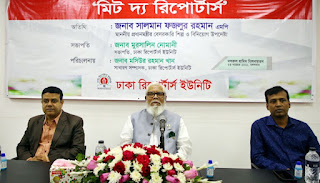
Salman also gave answers to questions on the country’s share market, foreign direct investment, tax, falling price of fuel oils in the international market, foreign workers, digital security act and Covid vaccine during an hour-long parley at the DRU auditorium. He identified a lack of institutional investors and the absence of secondary bond market as major ‘defects’ in the stock market and its inconsistency. The government is working to remove the defects, he said. He said that the county’s tax-GDP ratio had not increased despite a many-fold economic growth over the years. The National Board of Revenue has not been able to expand the tax net, he said.
Salman, also the vice-chairman of the BEXIMCO Group, said that 35 out of 65 services had already been facilitated to local and foreign investors under the Bangladesh Investment Development Authority’s one-stop service. He also said that the rest of other services mainly link to the NBR were yet to be bright under the BIDA’s one-stop service. In the absence of the services, local and foreign investors are raising allegations, he said. He, however, said that the BIDA’s one-stop service had already become popular.
Salman disagreed with data of outbound remittance at the tune of $3 billion annually by foreigners working mainly in the local textile sector. Referring to a Bangladesh Bank assessment, he said that the amount would be $200 million to $300 million. He also disagreed that the prices of medicines were high in the country compared with that of others countries. He hoped that the country would be able to produce Covid vaccine next year as both the private and public sectors were actively trying to obtain the manufacturing facility from abroad.
He also hoped that the import of Covid vaccine from the Serum Institute of India would resume in the next month. He noted that the suspension on export of vaccine from Serum had happened because of the ‘unfortunate’ situation of the Covid case spike in India. He said that he was against the misuse of the Digital Security Act 2018 to harass journalists. He, however, said that a Digital Security Act was imperative for stopping abuse of social media since a false post on social media could run havoc in society.
Sunday, November 28, 2021
Govt preparing for Covid vaccine production from 2022: Salman F Rahman
The government has been taking all necessary initiatives to go into Covid-19 vaccine production from next year, said Salman F Rahman, private sector industry and investment adviser to the prime minister. Speaking to reporters, he also said pharmaceutical giant Incepta has an agreement with a Chinese company in this regard."They have full capacity to produce vaccines," Salman said during a 'Meet the Reporters' programme organised by the Dhaka Reporters' Unity.
Beximco Pharmaceuticals may also complete all processes to earn the capacity of producing Covid vaccines within the next four to six weeks, hoped Salman, who is the pharma's vice chairman. Meanwhile, he also said India's Serum will resume delivery of the remaining Covid-19 vaccines under a tripartite agreement signed last November between Beximco, Serum, and the Bangladesh government. Commenting on the country's capital market, Salman noted that there is an acute lack of institutional investors in the country.

"80% of all transactions here comes from retail or general investors. Compared to the capital market of the developed world, the picture in Bangladesh is the opposite. Our capital market is equity-based. There is no bond market here," he said."We are working to develop the bond market. The present [regulatory] chairman and commissioner are also sincere in this regard. Hopefully, the capital market will recover once the bond market becomes popular," he added. The veteran businessmen also spoke about the crisis in the banking sector and the rise of defaulted loans.
"The problem with our banking sector is that long-term investments are made here using short-term loans. This is a big problem." He said defaulted loans exist in all countries. However, he pointed out that in Bangladesh the problem mostly occurs with government banks. Salman, who is also the chairman of the Board of Editors of English daily 'The Independent', said a decision is on the way regarding the fate of the newspaper. He said the board will decide on whether both its magazine print and newspaper editions will continue to exist or will the print edition come to an end. "Our passion is involved with this newspaper. Various parties, including the Information Minister, do not want the newspaper to stop printing. It is the first 16-page colour newspaper of the country," he said. However, Salman added, "You also have to look at the financial capacity to keep a magazine running."
Regarding the recent fuel price hike, the PM's adviser said the price has increased in the country owing to the ongoing volatility in the international market for crude oil. The price will be reduced when the global rate falls.
Tuesday, November 9, 2021
Bangladesh a compelling case for UK investors
The UK is already the second-largest investor in Bangladesh, but there is vast potential to do more, Mohammad Sirazul Islam, executive chairman of the Bangladesh Investment Development Authority (BIDA), said recently.
"Bangladesh's liberalised investment policies and concessions encourage foreign investment. Our government is keen on facilitating more investments from the UK, which is a strong partner in our progress," Sirazul added. He was addressing the "Showcase Bangladesh 2021: Bangladesh-UK Investment Summit," recently where public and private sector leaders of Bangladesh and the UK came together to discuss the many win-win propositions that can take UK-Bangladesh trade and investment relations to new heights. The event was jointly organised by Standard Chartered and BIDA and took place in London on November 4.
Salman F Rahman, Private Sector Industry and Investment adviser to the prime minister, State Minister for ICT Zunaid Ahmed Palak; Md Sirazul Islam, executive chairman of Bangladesh Investment Development Authority; Robert Chatterton Dixon, British High Commissioner to Bangladesh; Saida Muna Tasneem, Bangladesh High Commissioner to the UK, Ireland and Liberia and Md Jashim Uddin, president of Federation of Bangladesh Chambers of Commerce & Industry attended the event.
The speakers made the case for greater engagement for UK investors in Bangladesh, one of the world's fastest-growing economies, hoping that foreign direct investment and international technical collaboration will greatly accelerate the attainment of the country's sustainable development plans. Salman F Rahman said, "The sustained, broad-based growth Bangladesh achieved over the last decade did not happen by accident, it was achieved through insightful planning and visionary leadership of our honourable prime minister." "Bangladesh's growth in nominal GDP in the first 36 years since independence has trebled in a third of the time, over the last 12 years," Naser Ezaz Bijoy, chief executive officer of Standard Chartered Bangladesh, said. "Despite the challenges posed by the pandemic, the country achieved one of the highest economic growth rates in the world, thanks to judicious policy intervention by the government and the resiliency of the people," he added. "The country is expected to maintain a growth trajectory that will enable GDP to exceed economies like Malaysia, Hong Kong, Singapore, Denmark and others. This is the right time to invest in Bangladesh, which I believe is the 'Best Kept Secret of Asia'."